
Roulette Betting Table Layout
3/26/2022 admin
Roulette Betting Table Layout Average ratng: 5,0/5 5582 reviews
- Roulette Betting Table Layout Ideas
- Roulette Betting Table Layout Templates
- Roulette Betting Strategy
- Best Bets On Roulette Table
- Printable Roulette Table Layout
- Roulette Betting Table Layout Template
The Roulette table layout appears, at first glance, a very complex affair, with a large number of boxes and a wheel on it. However, while the table itself may appear complicated, the game itself actually is not, and learning about the layout of the roulette table and the functions of the different elements on it is essential and quite easy. The roulette table layout is arranged into 2 sections: inside and outside. The inside area is organized into three columns of numbers, and the zero and double-zero are positioned atop the columns. Like the wheel, half of the numbers on the table are black and half are red.
The roulette table is perhaps the most frequented spot in every casino floor. Anyone who has been on a casino floor can tell you that it doesn’t seem to run out of players, except on the casino’s low seasons. Roulette truly is a famous game that was made popular by its very simple game design and easy to follow rules.
In roulette you can place either an inside bet or an outside bet, the names coming from the table layout. The numbers on a roulette layout are organised into three columns of 12 numbers each. A roulette table is divided into 38 slots in which the ball may land. The slots are numbered from 1 to 36, alternately colored red & black. 0 and 00 are colored green. You can bet on any single number, play a combination of numbers, as well as play red or black, odd or even, and columns of numbers.
Outside Bets
The game was also made popular by the allegedly high odds of winning it can give the player, specifically when the bettor wagers on even money bets. Even money bets are bets that cover half of the numbers in the wheel, barring the zero slot. Anyone who puts his stakes on this sort of bets can have a nearly fifty-fifty chance of winning.

Even money bets are just a subgroup of the betting category called the outside bets. These are bets that are placed on spaces near the edge of the roulette board, as opposed to inside bets that are surrounded in all sides by other elements of the roulette table layout. These bets are well-known for their high frequency of winning but low payouts. All in all, there are 12 official outside bets: red, black, odd, even, low numbers, high numbers, three dozens, and three columns.
The Snake Bet
Most roulette players associate outside bets with its respective spaces on the roulette table. This is not always the case however. There is this one special dozen bet that is placed specifically on the inside bet part of the grid, that is, the spaces for the numbers 0 to 36. This is called the snake bet, a zigzag-like wager covering 12 numbers.
The snake bet is made by placing chips on the numbers 1, 5, 9, 12, 14, 16, 19, 23, 27, 30, 32, and 34. These are all red numbers on the roulette table layout and for that reason, the snake bet is also known as the “red snake”. Normally, the value of chips on every number covered by this bet is uniformed, meaning no number has more chips than the rest. Essentially, the snake bet is but a dozen of single bets treated as a single unit and as such, there is no casino both online and offline that offers the snake bet as a betting option akin to split, street, square, and the like.
The snake bet, being considered an outside bet, naturally has a high probability of winning. Like the other dozen bets, it has a 32.43% chance of winning in the single zero French and European roulette, and 31.58% in the double zero American variety. Meanwhile, the payout for this bet is 35 betting units to 1, as the bet is treated by the house as twelve single bets on the roulette table layout instead of one whole unit. This is far higher than that of the columns and dozens, which comes at a measly two to one.
As one will be placing chips on every space of the snake bet, one can’t wager as small as one can make on standard dozen bets. Thus, the snake bet is considered a rather expensive bet that’s best made by people with a lot of money to spend on a roulette game. This is the sole downside of the red snake, which is otherwise a high-paying bet with decent winning odds.
Other articles:
Roulette
Please select which sections you would like to print:
Our editors will review what you’ve submitted and determine whether to revise the article.
Join Britannica's Publishing Partner Program and our community of experts to gain a global audience for your work!Articles from Britannica Encyclopedias for elementary and high school students.
John ScarneSee All ContributorsRoulette Betting Table Layout Ideas
President, John Scarne Games, Inc., North Bergen, New Jersey. Authority on gambling. Author of Scarne's Complete Guide to Gambling; Scarne on Dice; and others.
Roulette, (from French: “small wheel”), gambling game in which players bet on which red or black numbered compartment of a revolving wheel a small ball (spun in the opposite direction) will come to rest within. Bets are placed on a table marked to correspond with the compartments of the wheel. It is played in casinos worldwide. Roulette is a banking game, and all bets are placed against the bank—that is, the house, or the proprietor of the game. As a big-time betting game, it has had its popularity superseded in the United States and the Caribbean islands by others, notably craps, blackjack, and poker.
Fanciful stories about the origin of roulette include its invention by the 17th-century French mathematician Blaise Pascal, by a French monk, and by the Chinese, from whom it was supposedly transmitted to France by Dominican monks. In reality, roulette was derived in France in the early 18th century from the older games hoca and portique, and it is first mentioned under its current name in 1716 in Bordeaux. Following several modifications, roulette achieved its present layout and wheel structure about 1790, after which it rapidly gained status as the leading game in the casinos and gambling houses of Europe. During the years 1836 to 1933, roulette was banned in France.
Roulette Betting Table Layout Templates
Equipment
The roulette table is composed of two sections, the wheel itself and the betting layout, better known as the roulette layout. There are two styles of roulette tables. One has a single betting layout with the roulette wheel at one end, and the other has two layouts with the wheel in the centre. The wheel spins horizontally.
Heading the layout design, which is printed on green baize, is a space containing the figure 0 (European style) or the figures 0 and 00 (American style, although such wheels were used also in Europe during the 18th and 19th centuries). The main portion of the design is composed of 36 consecutively numbered rectangular spaces, alternately coloured red and black and arranged in three columns of 12 spaces each, beginning with 1 at the top and concluding with 36 at the bottom. Directly below the numbers are three blank spaces (on some layouts these are marked “2 to 1” and are located on the players’ side of the table). On either side of these or along one side of the columns are rectangular spaces marked “1st 12,” “2nd 12,” and “3rd 12” on American-style layouts. On European-style layouts these terms are “12p” (première), “12m” (milieu), and “12d” (dernière douzaine). Six more spaces are marked “red” (rouge), “black” (noir), “even” (pair), “odd” (impair), “1–18” (low, or manque), and “19–36” (high, or passe).
Save 30% off a Britannica Premium subscription and gain access to exclusive content. Subscribe Now
The roulette wheel consists of a solid wooden disk slightly convex in shape. Around its rim are metal partitions known as separators or frets, and the compartments or pockets between these are called canoes by roulette croupiers. Thirty-six of these compartments, painted alternately red and black, are numbered nonconsecutively from 1 to 36. On European-style wheels a 37th compartment, painted green, carries the sign 0, and on American wheels two green compartments on opposite sides of the wheel carry the signs 0 and 00. The wheel, its spindle perfectly balanced, spins smoothly in an almost frictionless manner.
The standard roulette table employs up to 10 sets of wheel checks (usually called chips). Each set is differently coloured; each traditionally consists of 300 chips; and there is one set for each player. The chips usually have a single basic value, although some casinos also sell chips of lesser value. The colour of the chips indicates the player, not the value of the chips. If a player wishes to buy chips of slightly higher value, the croupier places a marker indicating that value on top of the table’s stack of chips of the colour corresponding to the chips purchased. Most casinos also have high-value chips that can be wagered at any gaming table. Unlike roulette chips, these have their numbered values printed on them.
Bets
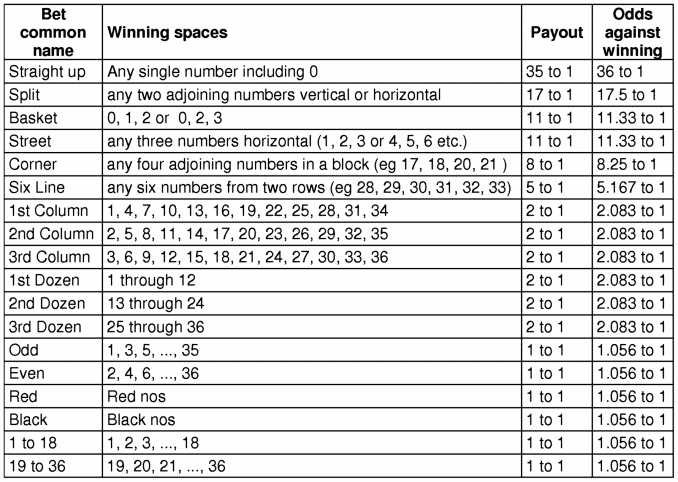
It is possible to place the following bets in roulette: (1) straight, or single-number (en plein), in which the chips are placed squarely on one number of the layout, including 0 (and also 00 on American layouts), so that the chips do not touch any of the lines enclosing the number; a winning single-number bet pays 35 to 1 (for each unit bet, a winning player receives his original bet and 35 matching units); (2) split, or 2-number (à cheval), in which the chips are placed on any line separating any two numbers; if either wins, payoff odds are 17 to 1; (3) street, or 3-number (transversale pleine), in which the chips are placed on the outside line of the layout, betting the three numbers opposite the chips; payoff odds on any of the three numbers are 11 to 1; (4) square, quarter, corner, or 4-number (en carré), in which the chips are placed on the intersection of the lines between any four numbers; payoff odds are 8 to 1; (5) line, or 6-number (sixaine or transversale six), in which the chips are placed on the intersection of the sideline and a line between two “streets”; payoff odds are 5 to 1; (6) column (colonne), or 12-number, in which the chips are placed on one of the three blank spaces (some layouts have three squares, marked “1st,” “2nd,” and “3rd”) at the bottom of the layout, thus betting the 12 numbers above the space; payoff odds are 2 to 1; (7) dozens (douzaine), or 12-number, in which the chips are placed on one of the spaces of the layout marked “12,” betting the numbers 1–12, 13–24, or 25–36; payoff odds are 2 to 1; (8) low-number or high-number, in which the chips are placed on the layout space marked “1–18” (manque) or on the space marked “19–36” (passe); payoff is even money; (9) black or red, in which the chips are placed on a space of the layout marked “black” (noir) or on a space marked “red” (rouge; some layouts have a large black or red diamond-shaped design instead of the words); payoff is even money; (10) odd-number or even-number, in which the chips are placed on the space of the layout marked “odd” (impair) or on the space marked “even” (pair); payoff is even money.
Roulette Betting Strategy
On layouts with a single zero (European style), the 0 may be included in a 2-number bet with any adjoining number, in a 3-number bet with 1 and 2 or with 2 and 3, and in a 4-number bet with 1, 2, and 3 at the regular odds for these bets. With the American-style 0 and 00, a 5-number line bet also is possible, the player placing his chips on the corner intersection of the line separating the 1, 2, 3 from the 0 and 00, with payoff odds of 6 to 1.
The play
Best Bets On Roulette Table
The game begins when one of the croupiers (dealers) in attendance calls for the players to make their bets, which they do by placing chips on the spaces of the layout on any number, group, or classification they hope will win.
Printable Roulette Table Layout
The croupier usually starts the wheel spinning in a counterclockwise direction and then spins a small ivory or plastic ball onto the bowl’s back track in the opposite direction. Players may continue to place bets while the wheel and ball are in motion until the ball slows down and is about to drop off the back track, at which time one of the croupiers announces that no more bets may be made.
Roulette Betting Table Layout Template
When the ball falls and comes to rest between any two metal partitions of the wheel, it marks the winning number (or a 0 or 00), the winning colour, and any other permitted bet that pertains to a winning number or symbol. The dealer immediately announces the winning number and its colour and places a special marker on the corresponding number on the layout. He first collects all losing bets, not disturbing the chips that are resting on winning spaces, and then pays off any winning bets.
Quick Facts