
How Much Do Slots Have To Pay Out
4/4/2022 admin
How Much Do Slots Have To Pay Out Average ratng: 4,8/5 1612 reviews
Introduction to Taxable Jackpots
- How Much Do Slots Have To Pay Out Money
- How Often Do Slots Pay Out
- How Much Do Slots Have To Pay Out Taxes
- It is entirely plausible that you will play the 75 percent pay out slot and win more than the 95 percent payout percentage slot. So the key lesson to learn about payout percentages is not to think they are stating how much you will win back on average in your session, but that they are a simple, general tool to assess how profitable the machine.
- Slot machines will have a payout rate that ranges from 75 percent to up to 98 percent. Even though that the game might have a specific payout percentage, keep in mind that you will have good and not so good days. It is not every time that you play a game that it payout or give a.
- Three-reel progressives are this type of game, amped up with a growing jackpot. You have to bet the max to be eligible for the jackpot. To see how the effect this has on payback percentages, let’s imagine the above pay table on a $1 game that returns 95 percent when you bet the max and in which the odds lead to the top jackpot hitting about once per 20,000 plays.
- These machines are operated in partnership with the state and are not permitted to pay out in cash; instead, they print out a receipt which must be taken to a cashier. The maximum bet on these machines is $2 and the maximum payout is limited to $800. Montana gaming regulations require these machines to return a minimum of 80%.
Some of the most popular online slots offer a payback percentage of 99%, which is much higher than that offered by land-based slot machines, which offer around 79% to 85% on average. It is most important to remember the theoretical payout percentage are calculated over an extended time-period.
One of the most popular slot machine questions on Google searches is: How do slot machines pay out taxable jackpots? I’ve assumed this question is about the mechanics of the payout process. A different upcoming post deals with explaining when slot machines pay out.
Slot machines are special-purpose computers, like a lot of equipment found in our lives. Specifically, standard tools are televisions, electronic watches, gas station pumps, cash registers, bank ATMs, automobiles, baby monitors, and the list goes on and on.
Each of these devices has one or more computer microprocessors, visual display, audio speaker, and some may also have a way to accept and/or dispense money either physically or virtually online.
Beyond controlling the multiple interfaces to and from the player, the computer within a slot machine also manages the odds of a player winning.
At its core, a pseudo-random number generator (PRNG) is a calculation. This PRNG is an element of the computer programming algorithm used by slot machines.
PRNGs (or more commonly RNGs) determine the outcome of a player’s bet based on the pre-determined odds of winning as set by the casino operator within the limited options provided by the slot machine manufacturer.
As previously mentioned elsewhere, winning a jackpot involves using the PRNG twice:
- To determine if a jackpot is won
- To determine how much was won
Keep Reading … or Watch Instead!
Or … Listen Instead!
Subscribe to my Professor Slots podcast at Apple Podcasts Google Podcasts Spotify Amazon Music Amazon Audible Gaana Stitcher Pandora iHeart Radio Tune-In SoundCloud RadioPublic Deezer RSS and everywhere else you find your podcasts!
The Slot Machine Gambling Process
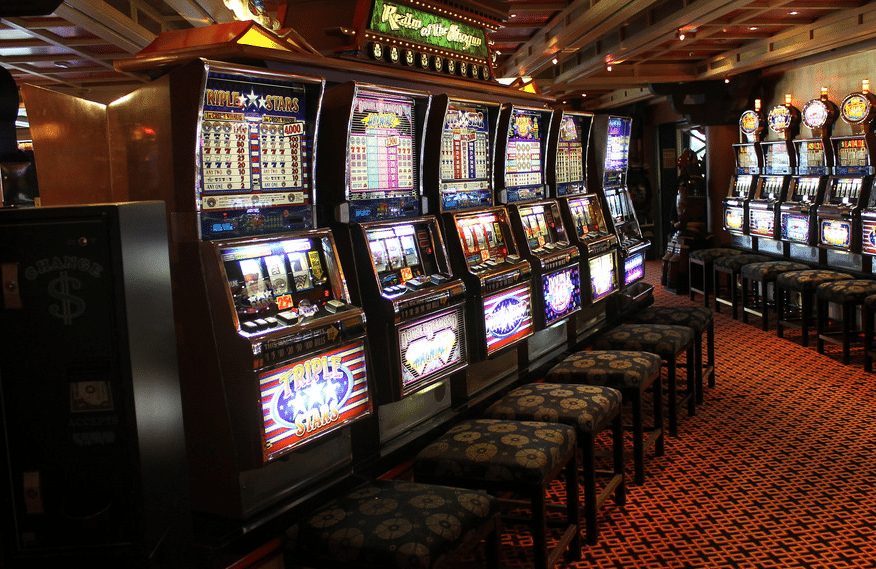
Once a player selects a specific slot machine, that machine operates to accept or reject the inserted cash, ticket voucher, and reward card.
Next, it accepts the player’s selection for denomination amount and amount of credits to be bet, although it will merely reject one or both settings if insufficient funds are available to make such a bet.
When the bet is placed, the machine immediately selects the latest random number generated by its RNG to determine the outcome of the bet and well as updating the players club card with the points earned for placing the bet.
At the end of this process, the machine turns the reels to show the outcome of the bet. See below for this player-machine sequence of events.

During slot machine gambling, a sequence of actions and reactions take place between the player and machine. The player:
- selects a specific machine, inserts money in the form of cash or ticket voucher
- chooses from the denominations available
- chooses the number of credits to bet
- places a bet
- observes the results of the bet including any bonus round
- receives winnings from the bet (if any)
- then, either:
- leaves the machine empty handed
- cashes out any remaining funds and leaves with a ticket voucher
- continues playing the machine.
The player may choose to insert a player card at any time before or during play, then later remove it before leaving the machine.
Jackpot!
Between determining the outcome of the bet and turning the reels, the machine executes programming code that sets the reels.
The reels turn in a way the machine’s game designers consider most entertaining to the player – such as stopping on reel symbols for non-wins which are next to the symbols for sizable jackpots.
As mentioned, the bet’s outcome is determined when the bet is placed, not when the reels stop moving, despite the entertainment value derived by the player when observing the “action” of the slot machine.
In the event of a win, the machine executes further programming to activate sequences of lights and sounds while updating the information display for the player, which is referred to as a roll-up.
Now What? – The Jackpot Pay Out Process
If a jackpot less than the taxable limit is won, slot players can simply proceed with continuing to play or cash out from that slot machine. The current taxable jackpot limit is $1,200 in the United States.
Meaning, if you have a win of $1,200.00 or more at a slot machine, there is an immediate tax bill resulting in an IRS Form W-2G. If you have a win of $1,199.99 or less, there is no immediate tax bill.
Jackpots that require immediate payment of taxes results in the slot machine locking up.
Many, many slot players have been surprised by their slot machine locking up when a taxable jackpot is won. It can only be unlocked by a casino employee, a slot attendant.

Whether a casino is old or new, a slot attendant will arrive shortly to administer a hand payout. During a hand payout, a slot attendant
- collects personal identification sufficient to both complete a tax form as well as any other state-required documentation
- performs the hand payout (if they have adequate cash on hand)
- unlocks the machine to allow the player to continue.
If the attendant is not carrying enough cash with them, or if the player wishes to have a cashier’s check instead of a cash payout, the slot attendant leaves the player with a receipt and returns a short while later with the check or cash.
If the attendant leaves, they typically unlock the slot machine beforehand to allow the player to continue betting while waiting for the slot attendant to return.
Summary of Taxable Jackpots
How Much Do Slots Have To Pay Out Money
The most important thing to remember about winning a jackpot is to make sure you’ve brought your government-issued I.D. If you don’t have it, then you cannot receive a taxable jackpot.
And, no, your friend sitting next to you cannot claim the jackpot for you – the eye in the sky knows it’s your winnings and not someone else.
The second thing to be aware of is what is or is not a taxable jackpot, a single win of $1,200 or higher. Many people have never won a taxable jackpot, so it can be challenging to get useful information on this unless you’ve done it more than a few times. But I have.
If the machine locks up, it’s either had an error or you’ve won a taxable jackpot. Being out of paper is a machine error, for example. Either way, a slot attendant will show up shortly to help. For goodness sake, don’t walk away until you know which!
As a final note, as of this writing, a decade ago, casinos moved away from using coins. Nowadays, they use cash, checks, and vouchers redeemable at cash machines and cages.
Related Articles from Professor Slots
Other Articles from Professor Slots
- Previous: Why Do Slot Machines Use Fruit Reel Symbols?
- Next: Who Builds Slot Machines Throughout the World?
Have fun, be safe, and make good choices!
By Jon H. Friedl, Jr. Ph.D., President
Jon Friedl, LLC
Sorry about the delay since my last posting. I’ve been hard at work reading slot machine manufacturer specification sheets, and also playing the slots in my local casino – so that I can now bring you a list of slot machine payout cycles / volatility. I don’t believe you’ll find this information elsewhere! I researched it, I’ve prepared it (as I do with ALL content on this site) – so if by chance it ends up appearing somewhere else on the Internet going forward, remember where you saw it FIRST. Here!
To my mind there are three main types of slot machines. Those that have Frequent Hits and Modest Wins, those with Mid-range Hits and Medium Wins, and those with Less Frequent Hits and Larger Wins. I’ve arranged my list / tables with this in mind. I’ve considered slot machines from multiple slot machine manufacturers: IGT, Aristocrat, WMS, Bally, etc to try and provide a comprehensive listing. That said, I’m only featuring about 100 slot machines here – and there are many many thousands of slot machine varieties out there… still, it’s a start right?
If you’re a small recreational slot player, sticking with Frequent Hits and Modest Wins machines will lower your risk of going broke early. Middle of the road slot players with a few hundred dollars of bankroll might enjoy the Mid-range Hits and Medium Wins machines. Only serious / well bankrolled players should ideally play the Less Frequent Hits and Larger Wins slot machines – these are VERY volatile!
Enjoy the listing, and feel free to send me your comments or an email.
Slot machines with FREQUENT HITS and MODEST WINS
50 Lions
Black Rhino
Canary Riches
Heart of Gold
Incan Pyramid
Love Birds
Macaw Magic
Money Storm
Money Tree
Outback Jack
Ramses Prox
Where’s The Gold
Wild Cougar
Wild Goose
Wild Jungle
How Often Do Slots Pay Out
Slot machines with MID-RANGE HITS and MEDIUM WINS
Adonis
Aloha Magic
Arabian Jewels
Buccaneer
Corrida De Toros
Desert Gold
Dolphin Treasure
Geisha
Get Eggcited
Golden Canaries
Golden Gong
Golden Pyramids
Good Fortune
Grizzly
Helen Of Troy
Hollywood Dreams
House of Hearts
Jungle Jive
King of Neptune
King of The Nile
Koala Mint
LA Gator
Lucky Jack
Miss Kitty
Money Beans
Money Bears
Monkey In The Middle
Moon Festival
Moulin Nights
Musketeer
Mystic Mermaid
Nerds Gone Wild
Orchid Mist
Owl Capone
Oz Great Chase
Oz Jungle
Oz Lost City
Oz Safari
Panther Magic
Pelican Pete
Penguin Pays
Pot of Gold
Queen of The Nile
Rapid Riches
Return of the Samurai
Roll Up Roll Up
Seal The Deal
Show Me The Money
Spring Carnival
Super Stars
Superbucks 2
Superbucks 3
Superbucks 4
Sweet Hearts II
Triple Tigers
Venetian Nights
Viking Warrior
White Russia
Wicked Winnings
Wild Hearts
Wild Thing
Winning Streak
How Much Do Slots Have To Pay Out Taxes
Slot machines with LESS FREQUENT HITS and LARGER WINS
5 Dragons
Anthony & Cleopatra
Big Ben
Brazil
Centurion
Choy Sun Doa
Crystal Springs
Dragon Lord
Dream Catcher
Fire Dancer
Fox On The Run
Genghis Khan
Golden Incas
Inca Chief
Inca Sun
Indian Dreaming
Island Delight
Kakadu Dreaming
Line King
Magician
Ms Foxy Fortune
Mystic Chief
Mystic Power
Peacock Magic
Phoneix Fantasy
Pompeii
Pride Of Africa
Queen Of Sheba
Red Baron
Star Drifter
Sun Queen
Temple Of Zeus
Tiki Torch
Water Margin
Whales Of Cash
Wild Africa
Wild Ways
Wings Over Olympus
Zorro